
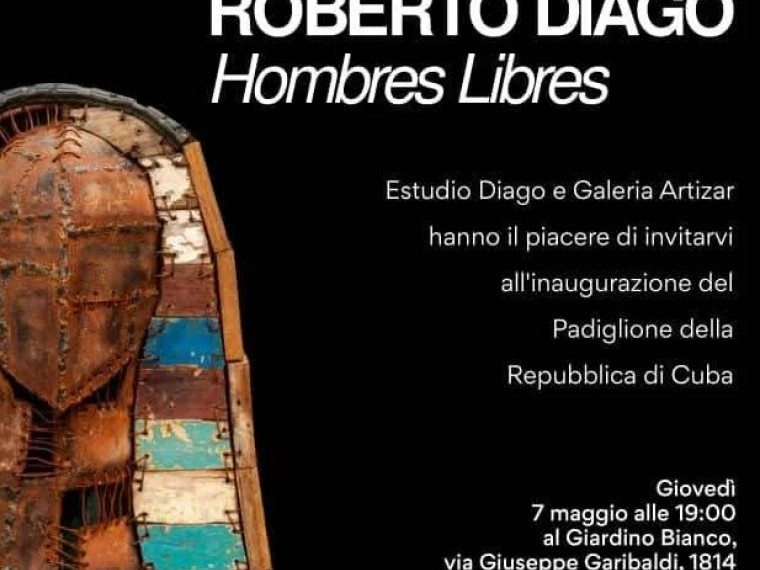
HOMBRES LIBRES
Comisionado: Daneisy García Roque
Curador: Nelson Ramirez de Arellano Conde
Expositor: Roberto Diago
Il Giardino Bianco - Art Space
Via Giuseppe Garibaldi, 1814.
Venecia Del 9 de mayo al 22 de noviembre, 2026
Noticias

De Mayo 9, 2026 hasta Noviembre 22, 2026
PABELLÓN DE LA REPÚBLICA DE CUBA En la 61. Exposición Internacional de Arte - La Biennale di Venezia

De Septiembre 24, 2026 hasta Septiembre 27, 2026
The Armory Show Javits Center, Manhattan, New York City
The Armory Show Javits Center, Manhattan, New York City
September 24–27, 2026

Septiembre 26, 2026
ARTRIBUNE - La libertad no es un trofeo. Entrevista con el artista que representa a Cuba en la Bienal de Venecia
La diáspora africana, los conflictos históricos, la cuestión colonial: los "hombres libres" que el artista Roberto Diago llevó a Venecia para el Pabellón Cubano en la Bienal hablan de esto y más. La entrevista
Julio 21, 2026
Roberto Diago – Cuba – 61ª Bienal de Venecia
La libertad como memoria encarnada
Entre las representaciones latinoamericanas de la 61ª Bienal de Venecia, Cuba vuelve a ocupar un lugar de singular interés.
Su pabellón se encuentra fuera de los recorridos tradicionales de Giardini y Arsenale, en Il Giardino Bianco
– Art Space (Via Giuseppe Garibaldi 1814), sobre la emblemática Via Giuseppe Garibaldi.

Junio 11, 2026
Roberto Diago turns the Cuban Pavilion into a scarred counter-history of empire, labour, Black survival, and the human warmth missing from the polished machinery of the Venice Biennale.
To arrive at the Cuban Pavilion in Venice is already to understand something about power. You leave behind the manicured theatre of the Giardini, those neat little national fortresses erected during the high noon of empire, where countries with colonial money secured permanent real estate inside art history itself. Then comes the Arsenale: the old Venetian war machine reborn as cultural runway, its kilometres of brick corridors processing art with the rhythm of a luxury slaughterhouse.

Mayo 18, 2026
Biennale di Venezia, Cuba porta la memoria delle cicatrici nel progetto di Roberto Diago
La Biennale di Venezia il Padiglione della Repubblica di Cuba sceglie un linguaggio duro, essenziale e profondamente umano. Con Hombres Libres / Free Men, l’artista Roberto Diago costruisce un percorso visivo che mette al centro il corpo, la memoria e il significato della libertà come conquista quotidiana.

Mayo 18, 2026
Cicatrici, l'estetica del dolore nel padiglione Cuba alla Biennale
Non si tratta di un'estetica del dolore fine a sé stessa, ma di una dichiarazione politica e identitaria. Le cicatrici, lungi dall'essere nascoste, vengono esibite come prova di sopravvivenza e resistenza. Nel lavoro di Diago, la libertà non è mai una condizione acquisita o garantita. È piuttosto una pratica continua, una tensione che impone vigilanza e consapevolezza.

Mayo 12, 2026
Art Artworks - “Free Men” by Cuban artist Roberto Diago represents Cuba at the Venice Biennale.
Titled “Free Men,” the series—begun in 2025—marks a mature stage in the visual repertoire of this Cuban creator. Known since the 1990s for giving voice to Afro-descendant communities, Diago Durruthy’s art reinterprets arte povera. He designs and assembles sculptures of various sizes using materials employed by marginalized communities—from Havana to Brazil and South Africa—in the spontaneous construction of their habitats.

Mayo 11, 2026
Nel Padiglione di Cuba un attraversamento fisico e simbolico della memoria afrodiscendente
In un paesaggio materico, per la partecipazione alla 61ma Mostra Internazionale d’Arte della Biennale di Venezia l’artista Roberto Diago non rappresenta la pelle nera come superficie passiva, ma come archivio di traumi, resistenza e sopravvivenza.

Mayo 9, 2026
Roberto Diago: “Hombres libres / Free men”
“The title: Hombres Libres. Free Men. A declaration in two words. We are the maroons — forever finding home, reclaiming freedom from within, unseen and invincible. Diago’s work carries the weight of memory and the dignity of resistance with extraordinary force and tenderness. A powerful reminder that freedom is never granted. It is claimed, embodied, and lived.”